| Route Modernisation | NetworkSouthEast.co.uk |
Waterloo-Exeter Route Modernisation
Outline of the modernisation
Class 50's and MK2 stock had worked the Waterloo to Exeter
route since before the formation of Network Southeast. However, a few years after Network
Southeast took control, the class was beginning to encounter more than it's fair share of
technical faults. Many of the class (about 1/3 at one time!) were out of service
undergoing repairs, so Network SouthEast had to bring in class 47's to supplement the
class 50's. However, this was only seen as temporary measure, as the class 47/7
locomotives were getting on a bit. Network Southeast commissioned a study into possible
remedies for this problem, and it came up with several options:
1. Ordering new diesel locomotives (the proposed class 48 ) and new coaches
2. Ordering new DMU's , either the class 158 already in use and under construc for
Regional Railways, or the class 171 turbo (an air-conditioned version of the class 165,
which was still on the drawing board)
3. electrifying the line from Basingstoke to Exeter, using brand new or existing EMU's
4. using Intercity 125s, in a shorter formation
The government was said to be in favour of the HST option, but the trains
did not suite the route.
Another study concluded that electrifying the route or ordering new DMU's were the two
best options. However, electrifying the line had to include the cost of new infrastructure
as well as new multiple units, but the DMU option involved only the cost of the units, so
it was decided that DMU's would be the best option to take. Network SouthEast was in
favour of building the proposed class 171, but the situation arose where Regional Railways
found that it had ordered more class 158's than it had the need for. Therefore it was
decided that Regional Railways would divert the last part of its order to NSE. One of the
benefits of this was that NSE was able to get it's units much quicker than any of the
other options.
The Units
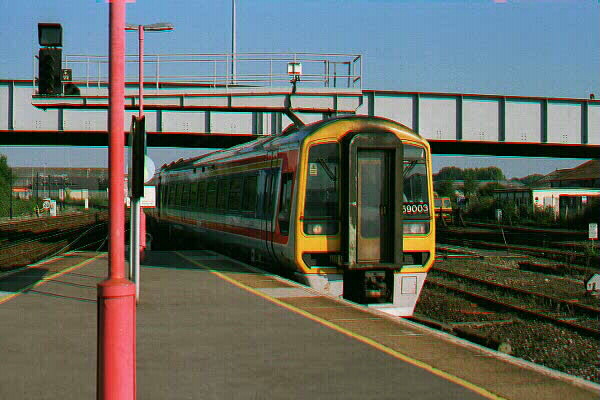
NSE new units were 3 car class 158's, but Network SouthEast was not that
impressed with the interior design of these units. One of the problems was that first
class was fitted 2+2 seating, but NSE preferred 2+1. Other problems included trolley
stowage and the interior décor, which was fitted out in Regional Railways colours. Due to
the fact that BREL was now privatised, it was not possible for NSE to change the order.
The result of this was that standard Regional Railways class 158's in NSE colours were
transported to Rosyth Dockyard in Scotland for another contractor to convert the 158's
into Network SouthEast specification class 159's. The problem with this was that non of
the rail served warehouses at Rosyth were large enough to perform the conversion in, so
what did they do? They built brand new warehouses!
While the conversion process was underway, NSE constructed a brand new traincare depot in
Salisbury, to house and maintain the new units.
After the conversion process was completed, the class undertook trail runs in many parts
of the NSE region. The first revenue-earning trip was in mid 1993.
The train service on Chiltern was provided by an old collection of Heritage DMUs
controlled by semaphore signalling. There were many low-speed junctions and other
restrictions, train speeds were very low arid journey times suffered because of this.
Network SouthEast decided to started work on a comprehensive plan to bring the route up to
standard. This was Network SouthEast’s first time they had implemented the concept of
Total Route Modernisation.
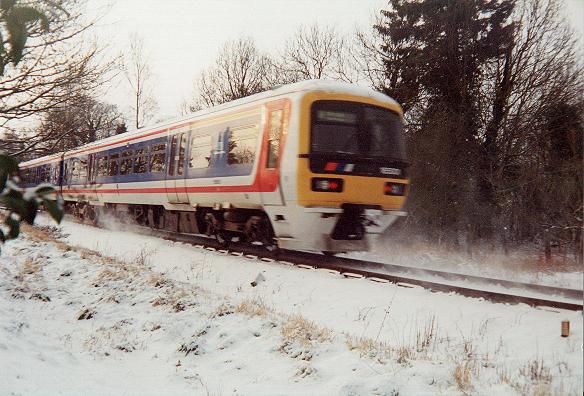
Electrification was not a viable option, so diesel traction had been retained. Network
SouthEast designed a new style of multiple unit, the class 165. Each of these 89 new Class
165/0 Network Turbo’ coaches are powered by a 350hp Perkins diesel engine. They are
formed into 28 two and 11 three-car units.
Perhaps one drawback as far a passengers are concerned is that they have been designed for
Driver Only Operation. Having regard to the number of stops, and the need to run over
London Underground tracks the best maximum speed was 75mph.
To accommodate the Chiltern Line fleet of Networker Turbos a new maintenance depot was
built at Aylesbury. So far as customers are concerned, the most noticeable improvements
were the increased quality of the trains. Not only does the air suspension give a vastly
improved ride, but the ergonomically-designed interior will also ensure maximum comfort
for customers. Some of the best features are wide power-operated doors and bright and airy
seating areas.
Stations have also been improved. More then £10 million was spent to improve the lighting
at all of the stations and platforms were been lengthened.
Report a broken link
Main Menu | Chat | Credits |
Mail Me | Feedback Form

http://www.networksoutheast.co.uk
The Network SouthEast Page is ©Michael Rodgers 1998-2000.